Monthly Archives: December 2011

Apple Phishing Scam Alert

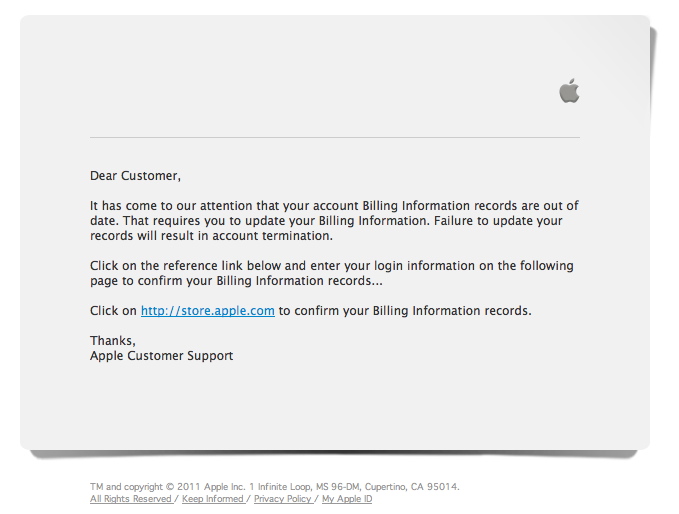
CNET is warning about a phishing scam in which the bad guys are sending emails that are fake billing error notices from Apple.

Apple Phishing Scam

CNET reports that unlike other Apple phishing scams, in this scam the bad guys have created a reasonably convincing fake.  The grammar and spelling are correct and the message is formatted to look like a real Apple message.  The email address that is displayed looks like it could be from Apple — “appleid@id.apple.com.”  However, it isn’t real. Following the links will land at a fake Apple website that also looks pretty convincing. The fake Apple website requests your Apple ID and password. It then prompts you to update your personal data, including your credit card information. DON”T DO IT!

CNET provides useful advice on detecting the scam. CNET explains how to unwind URLs and then how to compare the fake URLs to real Apple URLs.

To this advice, we add that you should use the latest version of a reputable security product (such as the products of Trend Micro) and install all the security patches for your operating system and applications.  You should be careful.  But you need to do more.  You need a product that will identify legitimate emails from many of the leading consumer brands. Distinguishing real email from fake email is hard.  Being conversant with all the real URL’s is impossible.  You need a tool to identify real email.  You need eMail ID from Iconix.

Know Who.  No Doubt.  Use eMail ID.

2012 Cyberattacks Predicted by IID

IID has released its predictions of the big cyberattacks for 2012.  Of the 5 predicted cyberthreats, 4 depend upon phishing scams for their evil success.

Here’s the IID predictions:

1) Phishing – London Summer Olympics cyber attacks — Cybercriminals will try to capitalize on the Olympics by tricking people into installing malware with phishing scams impersonating the Summer Olympics official website and/or official Summer Olympics vendors.  Once malware is on a victim’s computer, the miscreants can monitor or control both personal and business computer activity — enabling them to steal data, send spam, and commit fraud.

2) Phishing – Elections altered — The 2012  U.S. presidential election year will create opportunities for deceiving voters and other skullduggery.  Cybercriminals are expected to  impersonate voting websites and political emails with phishing and malware attacks.  Many U.S. states allow military and overseas voting via the Internet — creating the opportunity to alter votes.  There are also concerns about the security of voting machines.

3) Phishing – 12/21/2012 danger — The Mayan “end of times” of December 21, 2012 will allow bad guys to play into this fear through targeted phishing and malware attacks playing on people’s heightened awareness surrounding 12/21/2012.

4) Internet infrastructure attacks for financial gain — While hacktivism will persist, expect DNS (Domain Name System) and BGP (Border Gateway Protocol) attacks for financial gain to grab headlines in 2012. The December 2010 DNS hijacking of large European payment processor ChronoPayis an example of this theat.

5) Spearphishing – Infrastructure Attacks.  IID predicts attacks on physical infrastructure attacks.  The Stuxnet hack caused substantial damage to the Iranian nuclear program.  The recently discovered DUQU hack is distributed by spearphishing.

This is an interesting forecast. While it is hard to predict the precise events and vulnerabilities that the badguys will use, there is little doubt that clever criminals will use current events and zero day exploits to cause havoc.

Spearphishers Compromise U.S Chamber of Commerce

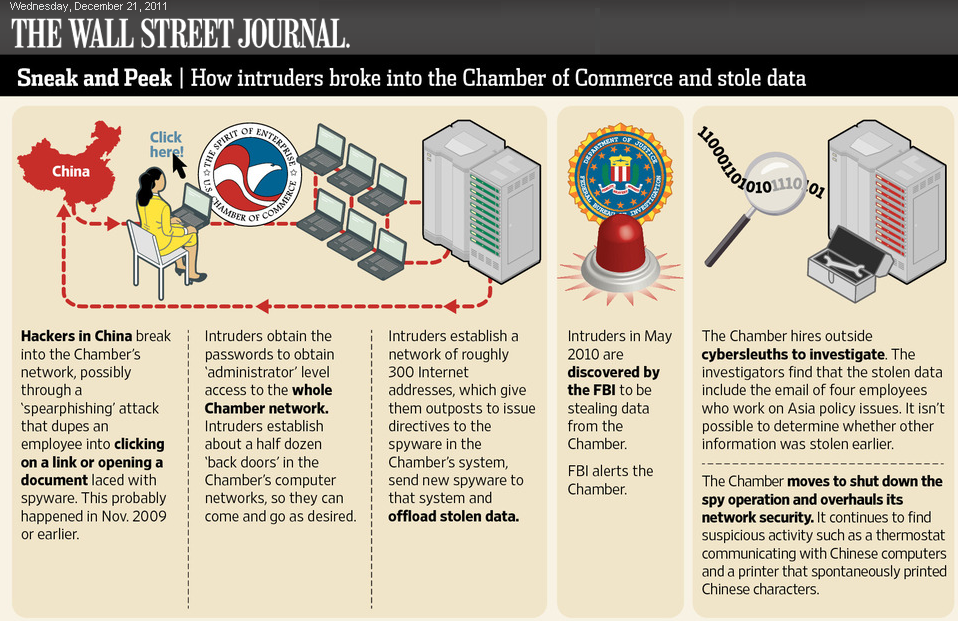
The Wall Street Journal is reporting that Chinese hackers accessed data of the U.S. Chamber from November of 2009 until May of 2010. Using a network of over 300 IP addresses, the hackers gained access to everything stored on its systems, including information about its three million members and lobbying efforts of the Chamber. The attack probably started with a spearphishing email.

In a stark demonstration of how hard it is to detect malicious activity, The Wall Street Journal reported:

It is possible the hackers had access to the network for more than a year before the breach was uncovered, according to two people familiar with the Chamber’s internal investigation.

One of these people said the group behind the break-in is one that U.S. officials suspect of having ties to the Chinese government. The Chamber learned of the break-in when the Federal Bureau of Investigation told the group that servers in China were stealing its information, this person said. The FBI declined to comment on the matter.

The Wall Street Journal summarized the data breach in a graphic:

Chamber of Commerce Hack

You can view the original graphic by clicking here.

What can be done to defend the enterprise against spearphishing?  The enterprise can adopt a tool that identifies trusted email so that the target of the spearphishing attack can distinguish real email from fake email.  That tool is SP Guard from Iconix.
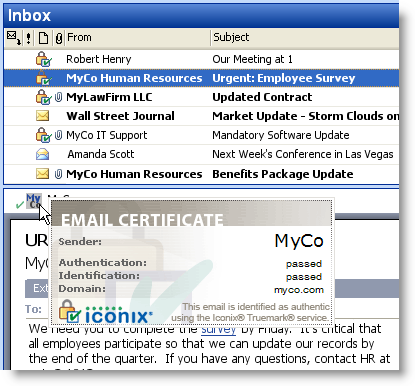
SP Guard Inbox

SP Guard provides the recipient with three confirmations that a message is real:

  1. List View. There is an integrity indicator in the list view of the email client.
  2. Message. The open message has a further indicator of authenticity.
  3. Mouseover. Mousing over the authentication indicator in the message prompts the display of a certificate that further identifies the sender.

SP Guard now offers a fraud filtering enhancement.  This additional protection is becoming increasingly important given the latest generation of highly targeted spear-phishing emails which are so well crafted that users cannot tell real from fake.

SP Guard is available now from Iconix. For further information, contact us at  408-727-6342, ext 3 or use our online form.

Spearphishers’ New Tool — Facebook Timeline

Timeline, the new feature just announced by Facebook, will make it even easier for bad guys to mine the Facebook social network for personal information they can use to launch malicious attacks. As this blog has noted many times, the most important element of an effective spearphishing attack is the persuasiveness of the fake email. Social networks are an ideal source of personal information that can be used to craft a spearphishing attack.

Networkworld quotes Sophos security expert Chet Wisniewski:

“Timeline makes it a heck of a lot easier

[for attackers] to collect information on people.  It’s not that the data isn’t already there on Facebook, but it’s currently not in an easy-to-use format. ”

Cybercriminals often unearth personal details from social networking sites to craft targeted attacks, noted Wisniewski, and Timeline will make their job simpler.

“And Facebook encourages people to fill in the blanks [in the Timeline],” said Wisniewski, referring to the new tool’s prompting users to add details to sections that are blank.

What kind of personal information can bad guys mine from social networking sites? When the bad guy is willing to devote a little work to the project, even the identity of a CIA agent can be uncovered. Timeline makes the work of cybercriminals more efficient.